
Scoopz Qualified Views Explained: Why View Count Doesn’t Match Earnings
If you’re staring at a video with hundreds of thousands — or millions — of views and wondering why your Creator Fund status hasn’t budged, this is almost always the answer: the number displayed on your video is not the number Scoopz uses to determine monetization eligibility. This guide breaks down exactly what a “qualified view” is, why the gap exists, and how to actually track the number that matters.
What Is a Qualified View?
A qualified view on Scoopz requires at least 10 seconds of watch time. That’s the entire technical definition, straight from Scoopz’s own Creator Fund policy — but the implications of that one rule are what trip creators up.
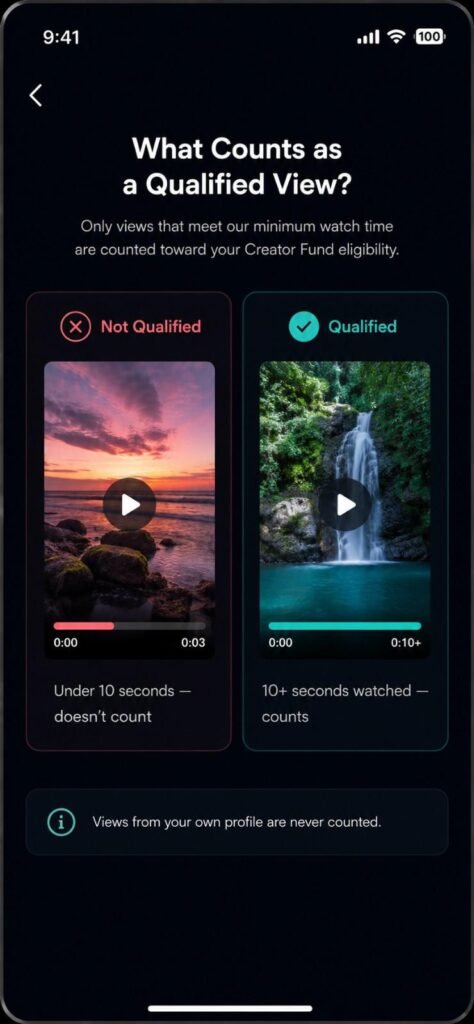
Two additional exclusions matter just as much as the 10-second threshold:
- Views from your own profile don’t count. Watching your own video, even repeatedly, does not contribute toward your qualified-view total
- A “view” in your public counter and a “qualified view” in the Creator Fund calculation are tracked separately — one is a vanity/engagement metric visible to everyone, the other is an internal eligibility metric
Why the Gap Between Total Views and Qualified Views Can Be Huge
Think about how most short-form feeds actually get consumed: a large share of impressions in any vertical video feed are scroll-throughs — someone’s thumb passes over your video for a second or two before moving on. Every platform with an algorithmic feed has this dynamic, and Scoopz’s 10-second qualification threshold exists specifically to filter that noise out of the metric that determines payment.
What this means practically: a video can accumulate a large raw view count very quickly through impressions alone, while its qualified-view count grows much more slowly, since only viewers who actually stop and watch for 10+ seconds contribute to it. This isn’t a bug or a sign of foul play — it’s the intended function of the qualification filter.
Common Misconceptions
“I have 2 million views, why haven’t I hit 100,000 qualified views?” Because those are two different metrics measuring two different things. A high raw view count reflects how often your video was shown or briefly seen; qualified views reflect genuine watch-through. It’s entirely possible to have a video that performs well on raw views but underperforms on qualified views if it doesn’t hold attention past the first few seconds.
“Does liking or commenting count as a qualified view?” No — the qualification rule is specifically about watch time (10+ seconds), not engagement actions. A like or comment on its own doesn’t satisfy the threshold if the underlying watch time doesn’t.
“Do views from ads or promoted posts count differently?” This isn’t publicly detailed in Scoopz’s policy one way or another — if you’re running any kind of promotion, don’t assume it counts the same as organic qualified views without confirming directly with Scoopz support.
“If I watch my own video on a different account, does that count?” The stated exclusion is for views from your own profile. Attempting to inflate qualified views artificially — through secondary accounts, bots, or view-exchange schemes — risks a moderation action against your account rather than a shortcut to eligibility, and isn’t something this guide recommends. if you want to Get app visit homepage.
A Worked (Hypothetical) Example
To make the math concrete — this is an illustrative example only, not real Scoopz data:
Suppose a video receives 500,000 total plays over a month, but only 80,000 of those viewers watched for 10 seconds or longer. That video contributes 80,000 qualified views, not 500,000, toward the creator’s 30-day total. If that creator posts a few more videos with similar retention, reaching the 100,000 qualified-view threshold could take several posts working together — not one viral-looking video alone.
The takeaway from this hypothetical: qualified views accumulate across your recent content in the trailing 30-day window, not from a single post in isolation, so consistent watch-through across multiple videos matters more than one high-raw-view outlier.
How to Improve Your Qualified View Rate
Since the threshold is about watch time, not raw exposure, the practical lever is retention, not just reach:
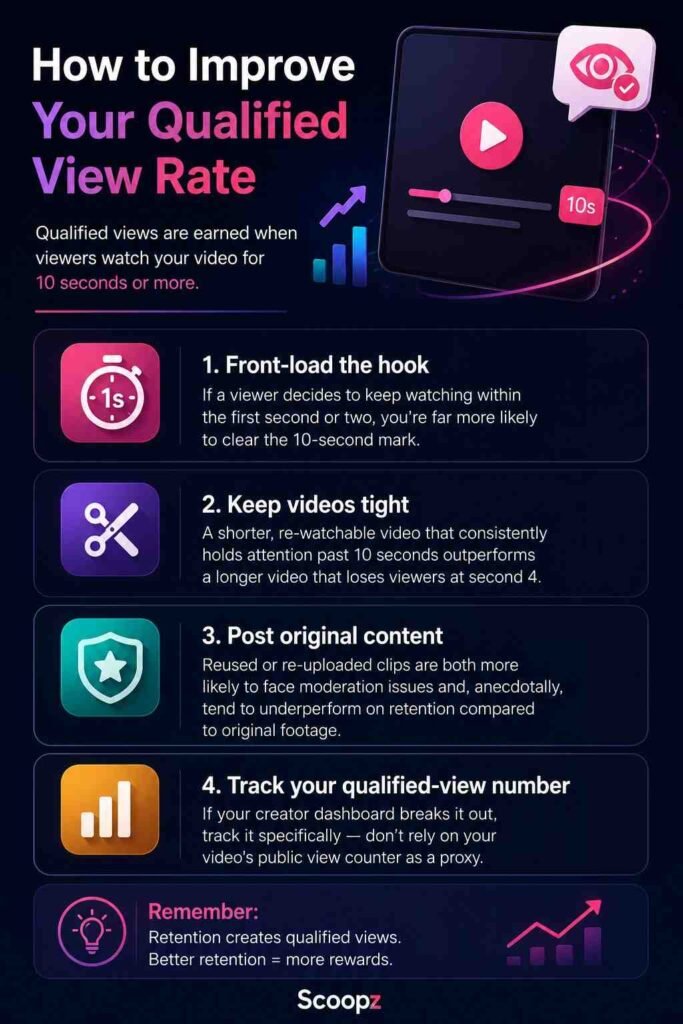
- Front-load the hook. If a viewer decides to keep watching within the first second or two, you’re far more likely to clear the 10-second mark than if the video opens slowly
- Keep videos tight. A shorter, re-watchable video that consistently holds attention past 10 seconds outperforms a longer video that loses viewers at second 4
- Post original content. Reused or re-uploaded clips are both more likely to face moderation issues and, anecdotally, tend to underperform on retention compared to original footage
- Track your own qualified-view number specifically, if your creator dashboard breaks it out — don’t rely on your video’s public view counter as a proxy
Frequently Asked Questions
This guide is independent and not affiliated with, endorsed by, or operated by Local AI, Inc. or Scoopz. The example above is illustrative only and does not represent real creator data. Creator Fund mechanics can change — always confirm current terms directly inside the official app.